Posted by Gus Mendem
Posted on 25 October
with No comments
Dr. Wallace, a fourth-generation Californian, is a member of the Society of New Testament Studies, the Institute for Biblical Research, the Society of Biblical Literature, the American Society of Papyrologists, and the Evangelical Theological Society (of which he was president in 2016). He has been a consultant for several Bible translations. He has written, edited, or contributed to more than three dozen books, and has published articles in New Testament Studies, Novum Testamentum, Biblica, Westminster Theological Journal, Bulletin of Biblical Review, the Journal of the Evangelical Theological Society, and several other peer-reviewed journals.
His Exegetical Syntax of the New Testament is the standard intermediate Greek grammar and has been translated into more than a half-dozen languages. He is the executive director of the Center for the Study of New Testament Manuscripts (csntm.org), an institute whose initial purpose is to preserve Scripture by taking digital photographs of all known Greek New Testament manuscripts.
In the process CSNTM staff have discovered over ninety New Testament manuscripts throughout the world. He and his wife, Pati, have four sons, three daughters-in-law, three granddaughters, one grandson, and one Labrador. Read more.
Posted by Gus Mendem
Posted on 08 October
with No comments
Biblical Prophecies on the Advent of Muhammad, the Prophet of Islam
The Biblical prophecies on the advent of the Prophet Muhammad are evidence of the truth of Islam for people who believe in the Bible.
In Deuteronomy 18, Moses stated that God told him: “I will raise up for them a prophet like you from among their brothers; I will put my words in his mouth, and he will tell them everything I command him. If anyone does not listen to my words that the prophet speaks in my name, I myself will call him to account.” (Deuteronomy 18:18-19).[1]
From these verses we conclude that the prophet in this prophecy must have the following three characteristics:
That he will be like Moses.
That he will come from the brothers of the Israelites, i.e. the Ishmaelites.
That God will put His words in to the mouth of this prophet and that he will declare what God commands him.
Let us examine these three characteristics in more depth:
1. A Prophet like Moses:
There were hardly any two prophets who were so much alike as Moses and Muhammad . Both were given a comprehensive law and code of life. Both encountered their enemies and were victorious in miraculous ways. Both were accepted as prophets and statesmen. Both migrated following conspiracies to assassinate them. Analogies between Moses and Jesus overlook not only the above similarities but other crucial ones as well. These include the natural birth, the family life, and death of Moses and Muhammad but not of Jesus. Moreover Jesus was regarded by his followers as the Son of God and not exclusively as a prophet of God, as Moses and Muhammad were and as Muslims believe Jesus was. So, this prophecy refers to the Prophet Muhammad and not to Jesus, because Muhammad is more like Moses than Jesus.
Also, one notices from the Gospel of John that the Jews were waiting for the fulfillment of three distinct prophecies. The first was the coming of Christ. The second was the coming of Elijah. The third was the coming of the Prophet. This is obvious from the three questions that were posed to John the Baptist: “Now this was John’s testimony, when the Jews of Jerusalem sent priests and Levites to ask him who he was. He did not fail to confess, but confessed freely, “I am not the Christ.” They asked him, “Then who are you? Are you Elijah?” He said, “I am not.” “Are you the Prophet?” He answered, “No.” (John 1:19-21). If we look in a Bible with cross-references, we will find in the marginal notes where the words “the Prophet” occur in John 1:21, that these words refer to the prophecy of Deuteronomy 18:15 and 18:18.[2] We conclude from this that Jesus Christ is not the prophet mentioned in Deuteronomy 18:18.
2. From the brothers of the Israelites
Abraham had two sons, Ishmael and Isaac (Genesis 21). Ishmael became the grandfather of the Arab nation, and Isaac became the grandfather of the Jewish nation. The prophet spoken of was not to come from among the Jews themselves, but from among their brothers, i.e. the Ishmaelites. Muhammad , a descendant of Ishmael, is indeed this prophet.
Also, Isaiah 42:1-13 speaks of the servant of God, His “chosen one” and “messenger” who will bring down a law. “He will not falter or be discouraged till he establishes justice on earth. In his law the islands will put their hope.” (Isaiah 42:4). Verse 11, connects that awaited one with the descendants of Kedar. Who is Kedar? According to Genesis 25:13, Kedar was the second son of Ishmael, the ancestor of the Prophet Muhammad .
3. God will put His words in the mouth of this Prophet
The words of God (the Holy Quran) were truly put into Muhammad’s mouth. God sent the Angel Gabriel to teach Muhammad the exact words of God (the Holy Quran) and asked him to dictate them to the people as he heard them. The words are therefore not his own. They did not come from his own thoughts, but were put into his mouth by the Angel Gabriel. During the life time of Muhammad , and under his supervision, these words were then memorized and written by his companions.
Also, this prophecy in Deuteronomy mentioned that this prophet will speak the words of God in the name of God. If we looked to the Holy Quran, we will find that all its chapters, except Chapter 9, are preceded or begin with the phrase, “In the Name of God, the Most Gracious, the Most Merciful.”
Another indication (other than the prophecy in Deuteronomy) is that Isaiah ties the messenger connected with Kedar with a new song (a scripture in a new language) to be sung to the Lord (Isaiah 42:10-11). This is mentioned more clearly in the prophecy of Isaiah: “and another tongue, will he speak to this people” (Isaiah 28:11 KJV). Another related point, is that the Quran was revealed in sections over a span of twenty-three years. It is interesting to compare this with Isaiah 28 which speaks of the same thing, “For it is: Do and do, do and do, rule on rule, rule on rule; a little here, a little there.” (Isaiah 28:10).
Note that God has said in the prophecy of Deuteronomy 18, “If anyone does not listen to my words that the prophet speaks in my name, I myself will call him to account.” (Deuteronomy, 18:19). This means that whoever believes in the Bible must believe in what this prophet says, and this prophet is the Prophet Muhammad .
[1] All of the verses on this page have been taken from The NIV Study Bible, New International Version, except where noted as being KJV which means King James Version. Back from footnote (1)
[2] See the marginal notes in The NIV Study Bible, New International Version on verse 1:21, p. 1594. Back from footnote (2)
Posted by Gus Mendem
Posted on 13 March
with No comments
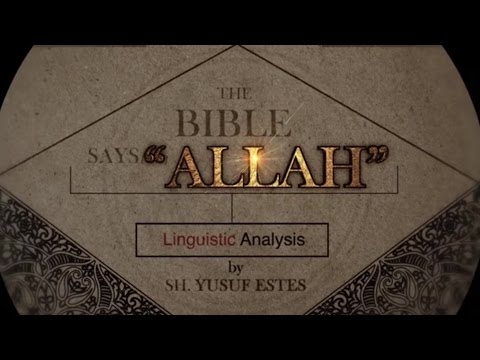
Scripture of the Ten Commandments in the Arabic Bible, or Bible in Arabic, mentioned Allah to refer to God. It is a hard evident from the Bible itself that Arab Christians use the word Allah to refer to God. Thus Arab Christians’ God is Allah.
It may surprise many Christians in other parts of the world, especially the West, but it is the plain truth. Allah is the One, and only One God of the universe. Allah is the Creator of every single one of us, including all prophets like Jesus and Muhammad (peace be upon them).
Posted by Gus Mendem
Posted on 29 October
with No comments
The hidden teachings of the bible that explain manifestation consciousness and oneness ✅
Take My Law Of Attraction Quiz & Get A Free Report! ➡ https://bit.ly/2ytEHhC These are the hidden teachings which Jesus spoke and Didymus Judas Thomas wrote down (known as The Gospel of Thomas).
Within these teachings from Jesus, it explains manifestation, consciousness and oneness. Religion has their own explanation for leaving these secret sayings out of the bible. However, if this knowledge had been shared early on, our entire history may have changed.
The sayings themselves are not the secret of these hidden teachings; the secret lies in their interpretation. Gregg Braden offers powerful information as he discusses what was eliminated from the bible by our western religion and how to use it to manifest what you want.